Open the Index and inspect a named entry
The reviewed interface places Index in hotbar slot 3; on PC, the source opens it with 3. Select Songkeeper’s Grove, then a creature card to see rarity, its printed frequency band, personal Stats and separate Tones records. [source]
Species, frequency, rarity and tone answer different questions
| Field | What to record | Example |
|---|---|---|
| Species | The creature’s name | Acornub |
| Frequency | The Hz reading of this specimen | A hypothetical 50 Hz |
| Rarity | The entry’s reported tier | Uncommon |
| Tone | The labels actually shown on the specimen | Melodic and Harmonic, if both are present |
Frequency bands overlap
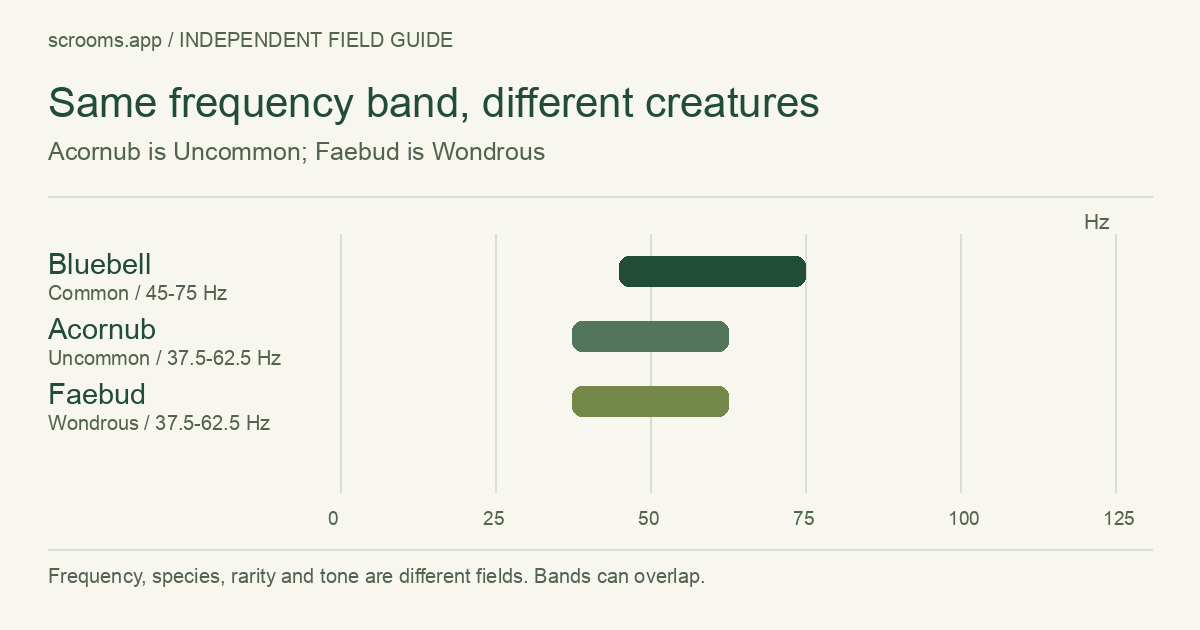
Acornub and Faebud both print 37.5–62.5 Hz, yet their rarity labels differ. Bluebell overlaps this interval as well. A 50 Hz result therefore needs a creature name before you can attach it to an entry.
A reference band describes published readings. It is not a location, a probability or a command for summoning a chosen creature.
Track each tone independently
The Index has Melodic, Harmonic and Resonant lines, each showing a caught date or an uncaught state. A specimen may carry multiple tone prefixes. The source associates a gold star with Melodic and a cyan star with Harmonic; use the named lines to read the full record. [source]
For a hypothetical Melodic Harmonic Redcap, save one Redcap species mark and those two observed labels. Do not fill Resonant without evidence. The website’s catch log supports combined labels; its species checklist is a separate record.
Check completion in the game
A new species, another specimen of an existing species and a new tone are different events. Compare the area completion counter and the selected card’s tone records in the game. Use the local collection tracker to keep notes, and export them from My progress before switching browsers.
Good questions, clear answers.
Does a higher Hz number mean a rarer creature?
No. Bluebell is Common despite overlapping several higher-rarity entries. Read rarity and frequency separately.
Can my catch-log percentages be used as drop rates?
No. They describe only your saved successful catches. They exclude failed attempts and do not establish server-wide probabilities.
Sources & review notes
Reviewed October 12, 2026. Game facts below are source-reported, not independently play-tested by this site. A link is not an endorsement.
- Index completion, frequency ranges and tones AllThingsHow · Community data
Species and tone records are distinct. Printed bands may be rounded; do not treat them as enforced limits.
- A counted Grove catching session AllThingsHow · Community observation
One sample is not an official probability distribution. We do not publish its percentages as drop rates.
- Acornub Index details AllThingsHow · Community data
Uncommon; printed band 37.5–62.5 Hz.
- Faebud and Luca's request AllThingsHow · Community data
Wondrous; printed band 37.5–62.5 Hz. Sample frequency is not guaranteed odds.
- Bluebell Index details AllThingsHow · Community data
Common; printed band 45–75 Hz.